 Inditech
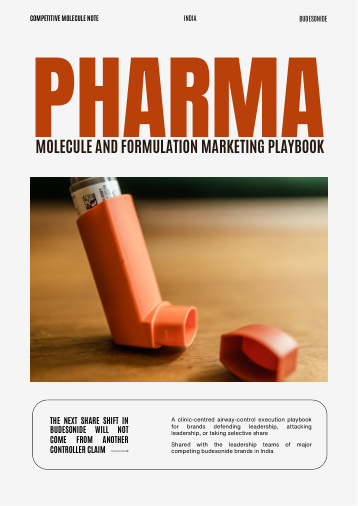
Read from start to finish, or use the contents to jump to what you need. You can also use your browser’s Find command to search the full text.
Budesonide
Budesonide sits inside one of the most important respiratory-control battlegrounds: inhaled corticosteroid-led airway care. Public Indian drug-brand directories list 69 budesonide brands, a useful proxy for a market where the molecule is visible, competed, and commercially meaningful. (Medindia)View source (opens in a new tab)
The clinical foundation is strong. GINA 2025 states that asthma can be treated effectively with treatment that includes inhaled corticosteroids, and that all adults, adolescents, and children aged 6–11 years should receive ICS-containing treatment; it also states that ICS reduces asthma symptoms, exacerbation risk, and death risk.
But the commercial problem in budesonide is not whether doctors know ICS matters.
The problem is that budesonide outcomes are destroyed by execution failure: steroid fear, wrong technique, poor adherence, rescue overuse, nebulisation confusion, irregular follow-up, and silent discontinuation when the patient feels better.
The next winning budesonide brand will not be the one that repeats “anti-inflammatory control” again. It will be the brand that helps clinics make airway control happen correctly after the prescription.
This publication outlines a molecule-specific workflow model for budesonide. It is built for three brand positions: leaders defending default share, challengers trying to displace leadership, and mid-tier brands seeking selective share gain.
The opportunity is molecule-wide. The first brand to own the budesonide execution workflow will make the rest of the market look under-built.
Back to contentsExecutive Summary
Budesonide is clinically strong but commercially under-protected. The molecule sits in a privileged zone: airway inflammation control. Doctors understand it. Guidelines support ICS-containing treatment in asthma. Patients with uncontrolled disease need better long-term control, not endless rescue cycles.
And yet, in the real world, budesonide brands still leak value every day.
The patient or parent fears the word “steroid.” The inhaler is used incorrectly. The nebulisation routine is misunderstood. The patient stops when symptoms improve. The reliever becomes the real default. The follow-up visit never happens. The doctor writes the right prescription, but the system fails after the visit.
That is the commercial opening. Budesonide brands should stop acting as if the market only needs more education on the molecule. The market needs a clinic-owned airway-control execution system.
The brand that builds that system first can become the doctor’s preferred budesonide partner - not because it says more, but because it helps the clinic get the prescription used correctly.
Back to contentsThe Market Reality
Budesonide does not suffer from lack of scientific legitimacy.
It suffers from poor real-world
conversion. GINA places inhaler technique, adherence,
symptom control, risk factors,
comorbidities, and patient education inside the asthma management cycle; it also advises checking inhaler technique at every opportunity and using device-specific checklists.
That is not a minor clinical detail. It is the whole commercial problem.
A budesonide prescription that is not used correctly does not become a budesonide outcome.
It becomes a disappointed patient, a worried parent, a rescue-medication habit, a doctor’s sense that control is not improving, and a brand that gets blamed for execution failure.
This is where most budesonide brands remain strategically weak.
They promote the importance of control but do not own the control workflow.
The first brand to own technique, adherence, follow-up, and steroid-myth correction will shift the basis of competition from memory to infrastructure.
Back to contentsThe Drift Definition
BUDESONIDE EXECUTION DRIFT
The drift in budesonide is not rejection of the molecule. The drift is failure between prescription and controlled use.
The pattern is familiar: wheeze / asthma / recurrent cough complaint → controller prescribed → patient starts imperfectly → technique errors persist → fear or inconvenience reduces use → symptoms fluctuate → reliever use continues → follow-up missed → controller is stopped or switched → brand choice resets
This creates six leaks.
1. Technique leakage The patient has the medicine but not the lung delivery.
2. Adherence leakage The patient improves and stops, or does not feel immediate relief and loses faith.
3. Steroid-fear leakage Parents or patients quietly reduce, avoid, or discontinue therapy.
4. Rescue-default leakage Relievers feel more rewarding because they are immediate. Controllers lose the psychological battle.
5. Review leakage The clinic does not know whether the patient is controlled, uncontrolled, non-adherent, or using the device incorrectly.
6. Brand leakage Once outcome is uncertain, the doctor may switch brands, add therapy, or move on without understanding the execution failure.
The next budesonide winner will attack these leaks directly.
Back to contentsProblem Framework
MOST BUDESONIDE BRANDS SELL CONTROL. THE NEXT WINNER WILL INSTALL IT.
The Real Commercial Problem
The old budesonide playbook says: ICS matters inflammation must be controlled use our brand remember us in asthma and wheeze repeat the message next month
That is not enough. The real doctor problem is practical: Did the patient use the inhaler correctly? Did the caregiver understand that this is not a quick-relief medicine? Did steroid fear reduce use? Did
the patient stop after
improvement? Is reliever use increasing? Should the patient return before the next crisis? Is poor control due to disease severity or poor execution?
The winning brand conversation is therefore: “Doctor, when you prescribe budesonide, our brand helps your clinic make sure the patient understands it, uses it correctly, continues it as advised, and comes back when control is poor.”
That is more valuable than another visual aid.
“DOCTOR, WHEN YOU PRESCRIBE BUDESONIDE, OUR BRAND HELPS YOUR CLINIC MAKE SURE THE PATIENT UNDERSTANDS IT, USES IT CORRECTLY, CONTINUES IT AS ADVISED, AND COMES BACK WHEN CONTROL IS POOR.”
Back to contentsThe Behavioural Moment Map
The Behavioural Moment
Map
THE MOMENTS THAT MATTER
Budesonide share is won or lost across seven moments.
Moment : Airway-control recognition
The patient presents with wheeze, recurrent cough, night symptoms, breathlessness, exercise symptoms,
seasonal flares, or recurrent
nebulisation / reliever use.
The doctor identifies that this is not just an episodic relief problem. It is a control problem.
THIS IS WHERE THE CLINIC EITHER OWNS LONG-TERM CONTROL OR LOSES THE PATIENT BACK INTO CRISIS CARE.
Moment 2: Controller decision
The doctor decides that ICS-containing treatment is appropriate.
This is the molecule’s strategic zone. The brand opportunity starts here.
Moment 3: Device and technique handover
This is one of the most important commercial moments in budesonide.
If the inhaler, spacer, nebulisation routine, rinsing instructions, or technique steps are not properly understood,
the prescription is weakened
immediately.
Moment 4: Steroid-fear moment
The patient or parent hears “steroid” and hesitates. This hesitation may not be voiced. It often appears later as missed doses, “only when needed” use, or early discontinuation.
Moment 5: First-week execution
The patient either builds routine or starts drifting. The clinic usually does not know.
Moment 6: Control review
Symptoms improve, persist, or recur. Reliever use may remain high. Night symptoms may continue. The patient may be using the controller incorrectly.
Without a review system, the doctor cannot distinguish treatment failure from execution failure.
Moment 7: Step-down / continuation / recurrence
The patient feels better and wants to stop. Or symptoms return after stopping. Or the family keeps using nebulisation episodically without structured review.
This is where the clinic either owns long-term control or loses the patient back into crisis care.
Back to contentsThe Clinic-centred Solution Framework
START RIGHT. USE RIGHT. REVIEW CONTROL.
The Clinic-centred Solution Framework
A CLINIC-CENTRED AIRWAY-CONTROL EXECUTION WORKFLOW FOR BUDESONIDE
The objective is not to promote indiscriminate budesonide use.
The objective is to make the sponsoring brand the doctor’s preferred budesonide brand when the doctor has chosen budesonide-led control, by helping the clinic ensure correct use, adherence, review, and re-entry.
The core proposition: When you decide budesonide is appropriate, this brand helps your clinic convert prescription into controlled use.
THAT IS THE BRAND’S STRATEGIC CLAIM.
Back to contentsThe Service Architecture
MODULE 1: CLINIC-BRANDED AIRWAY CONTROL LINK
A clinic-branded digital link shared by the clinic through QR code, WhatsApp, or printed prescription support card.
It is patient-facing but not promotional.
It does not show the pharma brand. It does not recommend budesonide. It does not change treatment. It does not diagnose asthma. It does not replace doctor follow-up.
It does five things:
1. Explains the clinic’s control plan.
2. Reinforces the difference between controller and reliever.
3. Supports device technique and routine.
4. Captures symptom-control signals.
5. Prompts review when control is poor.
Suggested patient-facing names: My Clinic Airway Control Check Doctor’s Wheeze Control Link Clinic Asthma & Wheeze Follow-up
The name must belong to the clinic, not the brand.
MODULE 2: DEVICE TECHNIQUE SUPPORT
The link gives clinic-approved technique guidance based on the doctor’s chosen device type: inhaler with spacer dry powder inhaler nebulisation routine nasal or other local budesonide use only if relevant to the brand’s approved indication
The content should be visual, simple, multilingual, and non-promotional.
The workflow can include: “show the clinic how you use it” prompt device-specific checklist common mistakes rinse / hygiene reminder where appropriate caregiver supervision cue “bring device to next visit” prompt
The brand does not appear. The clinic becomes the source of correct use.
MODULE : STEROID-MYTH CORRECTION
This is essential. Patients and parents often hear “steroid” and silently downgrade adherence.
The clinic-branded patient content should explain, in simple language: the doctor has prescribed this to control airway swelling / inflammation it is different from quick-relief medicine it should be used exactly as advised concerns should be discussed with the doctor, not solved by stopping silently sudden stopping or irregular use may reduce control
No brand claim. No fear. No over-reassurance. Just clinic-led clarity.
MODULE 4: DAY-7 TECHNIQUE AND ROUTINE CHECK
The system asks: Is the patient using the medicine as advised? Any missed doses? Is the device being used correctly? Any difficulty with inhaler / spacer / nebulisation? Is quick-relief medication being used often? Any night symptoms? Does the clinic need to review?
This catches execution failure before the next flare.
MODULE 5: DAY-30 CONTROL REVIEW
The system asks: Daytime symptoms? Night waking? Activity limitation? Reliever use? Missed controller doses? technique doubts? steroid concerns? unscheduled clinic / emergency visit?
The clinic receives meaningful control flags. This makes the budesonide brand part of the clinic’s control infrastructure.
“THIS MAKES THE BUDESONIDE BRAND PART OF THE CLINIC’S CONTROL INFRASTRUCTURE.”
MODULE : FLARE / RECURRENCE RE-ENTRY LOOP
If symptoms worsen, reliever use increases, or night symptoms return, the patient is prompted to contact the clinic.
No automated treatment change. No direct advice to increase or reduce medicine. The system simply brings the patient back into medical review.
This is commercially valuable because recurrence becomes a clinic-owned moment rather than a brand-reset moment.
Back to contentsDoctor Education Infrastructure
The academic layer should help doctors solve the practical barriers that weaken budesonide outcomes.
Six-month academy-backed micro-education sequence
MONTH 1 Budesonide outcomes fail when technique fails Core message: prescription without device competence is not control.
MONTH 2 Steroid fear is the hidden adherence killer Core message: patient and caregiver concerns must be addressed before they become non-adherence.
MONTH 3 Controller versus reliever: the patient misunderstanding that drives poor control Core message: immediate relief is not the same as airway control.
MONTH 4 The first week after starting budesonide Core message: early routine formation determines long-term control.
MONTH 5 When poor control is not treatment failure Core message: check adherence, technique, triggers, and comorbidities before assuming the molecule failed.
MONTH 6 Building an airway-control review system inside a busy clinic Core message: follow-up must become operational, not aspirational.
Each module should be short, academy-certified, doctor-facing, English, and deliverable by field reps in under five minutes.
Back to contentsStrategic Variants By Brand Position
Back to contentsIf You Are The Leader
DEFEND THE CONTROLLER DEFAULT BEFORE A CHALLENGER OWNS EXECUTION
Your current advantage is prescription habit. That is valuable, but it is not enough.
If a challenger installs the first serious budesonide execution workflow, your leadership becomes exposed. The challenger will not need to prove that budesonide matters. You have already helped establish that. The challenger only has to prove that it helps clinics make budesonide work better.
That is a dangerous reframing.
Your play: occupy the airway-control workflow first make your brand the default budesonide execution partner protect prescriptions from technique and adherence failure deepen clinic dependence make competitors look like they only sell the molecule
The leader’s best move is to convert brand scale into clinic infrastructure.
Back to contentsIf You Are The Challenger
The leader owns recall. You can own execution.
A challenger brand should attack the point where incumbents are weakest: They are known, but they may not help the clinic solve technique, adherence, steroid fear, and follow-up.
Your play: install the Airway Control Link in selected clinics give doctors a practical reason to try your brand use technique support as the wedge use follow-up data as proof convert doctor gratitude into repeat prescribing
The challenger’s line: “Doctor, when you prescribe budesonide, our brand helps your clinic make sure the patient actually uses it correctly.”
That is difficult for a conventional leader to dismiss.
DO NOT OUTSPEND THE LEADER. OUT-OPERATE THE LEADER.
Back to contentsIf You Are A Share-gain Brand
If You Are A Share-gain
Brand
DO NOT TRY TO OWN ALL BUDESONIDE. OWN A HIGH-
LEAKAGE SEGMENT.
Choose the segment where execution failure is most visible: paediatric wheeze clinics family physicians with recurrent asthma visits high-nebulisation practices clinics with many first-time inhaler users semi-urban markets with low device education doctors frustrated by poor adherence seasonal flare clusters
Your play: onboard 100–300 clinics install technique and review workflow measure active use show control-review signals improve brand-of-use in activated clinics expand only after proving repeatability
Selective ownership beats unfocused visibility.
Back to contentsField Force Storyline
The old rep call says: “Doctor, please prescribe our budesonide brand.”
The new call says: “Doctor, budesonide prescriptions fail when patients use the device incorrectly, stop when they feel better, or let steroid fear control adherence. We have built a clinic-branded airway-control system that helps your patients understand the controller, use it correctly, and return for review when control is poor. When you decide budesonide is appropriate, our brand supports the execution workflow.”
That is a stronger call.
It gives the doctor a tool, not another claim.
Back to contentsImplementation Modules
PHASE 1: CLINIC SEGMENTATION
PHASE 2: CLINIC
INSTALLATION
Identify clinics by execution gap: first-time inhaler users paediatric caregiver anxiety high nebulisation dependence frequent rescue use poor follow-up behaviour recurrent seasonal flares high device-technique error risk
For each clinic: configure clinic name and branding select language options generate Airway Control Link set device-specific guidance train clinic staff to share the link provide doctor-facing Budesonide Execution Cue place QR card at prescription desk
“THE SYSTEM CAPTURES TECHNIQUE DIFFICULTY, MISSED DOSES, STEROID CONCERN, RELIEVER USE, AND SYMPTOM CONTROL.”
PHASE 3: PRESCRIPTION ACTIVATION
After consultation, the clinic shares the link with the patient or caregiver.
The link reinforces: controller versus reliever distinction correct use adherence routine review triggers clinic contact for worsening symptoms
PHASE 4: DAY-7 EXECUTION CHECK
The system captures technique difficulty, missed doses, steroid concern, reliever use, and symptom control.
The clinic receives only meaningful alerts.
PHASE 5: DAY-30 CONTROL REVIEW
The system captures control status and flags patients needing review.
PHASE 6: MONTHLY ACADEMIC
REINFORCEMENT
Field reps return with one academy-backed micro-topic.
The service becomes touchpoint.
a repeat doctor
Back to contentsMeasurement Model
CLINIC
ACTIVATION
METRICS
PATIENT
WORKFLOW
METRICS
DOCTOR
ENGAGEMENT
METRICS
BRAND
OUTCOME
PROXIES
CLINICAL-
BEHAVIOUR
PROXIES
clinics onboarded active clinics per week Airway Control Links shared repeat usage staff adoption doctor continuation after first month
technique module completion day-7 check completion day-30 control review completion reported missed doses reported device difficulty reliever-use flags steroid-concern flags clinic review prompts
education module completion doctor discussion rate technique checklist use number of patients asked to bring device back willingness to continue service
brand-of-use change in activated clinics same-brand continuation proxy reduced early-switch signals repeat prescription rate pilot-market growth versus matched controls share gain in high-execution-gap clinics
increased technique verification improved follow-up capture increased clinic re-entry for poor control fewer uncontrolled patients drifting without review
The strongest dashboard is not “more impressions.”
It is : more budesonide prescriptions converted into correct, reviewed, clinic-owned use.
Back to contentsCompliance And Trust Guardrails
PATIENT-FACING LAYER
no brand name no superiority claim no treatment initiation advice no dose modification advice no automated escalation or step-down no replacement for doctor follow-up no diagnosis no promotional retargeting
DOCTOR-FACING LAYER
academy-backed aligned to approved indications and local label
clear that physician judgment governs all treatment brand appears only in doctor-facing execution material
DATA LAYER
no unnecessary patient-identifiable data consent-based communication encrypted event IDs clinic-level reporting no direct-to-patient brand database
The principle is simple: The brand wins because it helps doctors convert the prescription into proper use.
Back to contentsFirst-mover Advantage
In budesonide, first mover advantage is not about novelty. It is about installation.
The first brand to install a clinic-owned airway-control workflow gets: first claim on technique support first association with adherence discipline first clinic habit loop first behavioural dataset around controller execution first doctor trust advantage first chance to make competitors look like reminder brands
Once a clinic uses your system to teach technique, address steroid fear, and review control,
competitors must displace
infrastructure - not merely out-detail a brand.
That is harder. That is why this note has been circulated across competing budesonide brand teams.
THE FIELD IS STILL OPEN, BUT IT WILL NOT REMAIN OPEN ONCE ONE BRAND MOVES
Back to contentsStrategic Opportunity & CTA
Budesonide does not need another controller campaign.
It needs one brand to solve the execution problem.
The old rule was: convince the doctor that control matters.
The new rule is: help the clinic make control happen after the prescription.
EMAIL: Amit@inditech.co.inEmail (opens in a new tab)
The first budesonide brand to own technique,
adherence, steroid-fear
correction, and review will stop competing only for memory. It will compete for clinic dependence.
The decision for a budesonide brand team is simple: Will you remain one more brand making controller claims, or will you become the brand clinics use to make airway control actually work?
WEBSITE: Www.inditech.co.inView source (opens in a new tab)
Back to contents